
Medical Marijuana in New Jersey Hospitals: Can Hospitals Allow It?
Written by QuickMedCards. Updated July 15, 2026
If you use medical cannabis and need hospital care, you may wonder what happens to your treatment during admission. Medical marijuana in New Jersey hospitals may be allowed. But the answer depends on state law, hospital rules, and patient safety.
New Jersey law gives hospitals and other health care facilities room to create their own policies. A medical marijuana card can help prove that you are a registered patient. It does not give you automatic permission to use cannabis inside a hospital.
This article explains what New Jersey allows, what hospitals may restrict, and how patients can prepare before surgery, emergency care, hospice care, or a longer hospital stay.
By the end of this page, you will have the answers to these questions:
- Can New Jersey hospitals allow medical cannabis?
- Why does hospital policy matter for medical cannabis patients?
- What counts as a health care facility and an institutional caregiver in New Jersey?
- What should patients do before or during a hospital stay?
- What if a hospital does not allow medical cannabis?
- What are the benefits of a medical marijuana card in New Jersey?
Looking for a Medical Marijuana Doctor?
Can New Jersey Hospitals Allow Medical Cannabis?
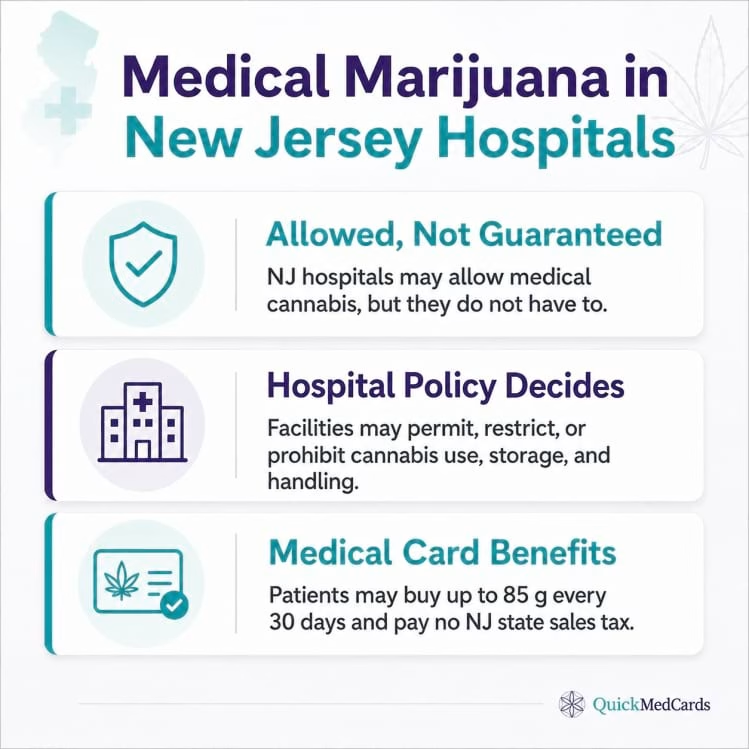
Yes, New Jersey hospitals may allow medical cannabis, but they are not required to do so.
Under New Jersey law, a health care facility will not face state penalties for allowing or prohibiting the handling, administration, use, or storage of medical cannabis. The key condition is that the facility’s cannabis policy must align with its other medication-handling policies. A hospital also may prohibit smoking medical cannabis on its property under its smoke-free policy.
New Jersey law protects patients from being treated as illicit substance users as well. Patients can use authorized medical cannabis. This matters in medical care decisions, including organ transplant evaluations, but it still does not force every hospital to allow cannabis use during admission.
Some facilities may prohibit cannabis altogether. Others may allow certain non-smoked forms, such as capsules or tinctures, if they can verify the product and document its use. Patients should never assume their card alone is enough.
Want to get certified for medical marijuana? We can help you connect with a licensed marijuana doctor and guide you through your next steps. Speak with a doctor today.
Why Does Hospital Policy Matter for Medical Cannabis Patients?
A hospital has strict rules for medications, controlled substances, patient safety, infection control, and staff responsibility.
Even when a patient has a valid medical cannabis card, the hospital still needs answers to basic safety questions. Who brought the product? Is it in its original labeled packaging? Who stores it? Who records the dose? What happens if the patient becomes dizzy, sedated, confused, or impaired?
How NJ Hospitals Manage Medical Cannabis Safety
Hospitals may treat cannabis as part of medication safety planning. That does not mean they judge the patient. It means the care team needs a full picture of what the patient uses.
Cannabis can affect attention, coordination, reaction time, heart rate, and blood pressure. The CDC also notes that smoked cannabis can harm lung tissue, and cannabis use may increase impairment when mixed with other substances.
This matters during hospital care because patients may receive pain medicine, sleep aids, anesthesia, anti-anxiety medication, or other treatments that also affect the body and brain.
Smoking and Vaping Face the Most Restrictions
Patients should expect smoking and vaping to face the most restrictions. Hospitals often prohibit smoking on campus. NJ law lets health care facilities ban smoking medical cannabis on their property under their smoke-free policies.
If a hospital allows medical cannabis, it may be more open to non-smoked forms. Still, you should ask before bringing any cannabis product into the facility.
Federal rules have changed, but they still do not require hospitals to permit medical cannabis use during admission.
What Counts as a Health Care Facility and Institutional Caregiver in NJ?
New Jersey’s medical cannabis law defines “health care facility” broadly as follows:
- General acute care hospitals
- Nursing homes
- Long-term care facilities
- Hospice care facilities
- Group homes
- Behavioral health care facilities
- Rehabilitation centers
This means the hospital question can also matter for patients in hospice, rehab, long-term care, or behavioral health settings.
New Jersey law also defines an institutional caregiver. To qualify, this person must:
- Live in New Jersey
- Be at least 18
- Work for a health care facility
- Have job duties that allow them to possess and administer controlled substances
- Have facility approval to help registered patients with medical cannabis
- Register with the Cannabis Regulatory Commission
An institutional caregiver may help a registered patient obtain medical cannabis and assist with administration if the facility allows it. However, not every hospital or facility has this process in place.
The state cannabis law also sets rules for institutional caregivers who obtain cannabis for patients. They must show proof of registration, written instructions, and the patient’s authorization.
What Should Patients Do Before or During a Hospital Stay?
The best time to ask about medical cannabis is before admission, not after you arrive with the product in your bag.
Ask the hospital or care facility these questions:
- Does your policy allow registered medical cannabis patients to use cannabis during admission?
- Which forms are allowed, if any?
- Can patients self-administer, or must staff handle it?
- Do you have an institutional caregiver process?
- Can my caregiver bring my cannabis product?
- How should the product be labeled and stored?
- What documents should I bring?
- Should I stop cannabis before surgery, anesthesia, or a procedure?
Bring the necessary documents. You should carry your New Jersey Medicinal Cannabis Program ID, current approval, dispensary packaging, medication list, and certifying clinician’s contact details.
New Jersey’s Medical Cannabis Program says registered patients receive cannabis orders from a doctor or other health care practitioner and fill those orders at a state-licensed Alternative Treatment Center (ATC) or dispensary. The program also says patients who cannot travel to a dispensary may designate and register caregivers.
It is important that you tell your care team about recent cannabis use. This is not about judgment. It is about safety. Cannabis may affect anesthesia planning, fall risk, discharge instructions, and how your doctors manage other medications.
Are you planning a hospital stay? Get certified for medical marijuana today. Speak with one of our licensed cannabis doctors online from the comfort of your home.
What If a Hospital Does Not Allow Medical Cannabis?
If the hospital does not allow medical cannabis, ask for its written policy. You can also ask whether the hospital has separate rules for non-smoked forms, whether your care team can adjust other symptom-control medications during your stay, and how to plan for safe cannabis use after discharge.
Do not hide cannabis use in a hospital. Hidden use can create safety, documentation, and discharge issues. It may also make it harder for your care team to manage medications, anesthesia, or side effects.
What Are the Benefits of a Medical Marijuana Card in NJ?
Some adults ask why they need a medical marijuana card if recreational cannabis is legal in New Jersey. The answer depends on your goals. If you use cannabis for a medical condition, the medical program can offer important advantages.
- New Jersey’s Cannabis Regulatory Commission says medical cannabis patients are prioritized over recreational cannabis users. Patients also work with a health care practitioner who oversees treatment and recommends its use.
- Registered qualifying patients may purchase up to 3 ounces (85 grams) at a time every 30 days. On the other hand, recreational buyers are limited to 28.35 grams, or 1 ounce, in one transaction. Medical dispensaries must also provide priority service to patients.
- Medical cannabis is exempt from New Jersey’s state sales tax. Municipalities may impose a local transfer tax where authorized by law. Recreational cannabis transactions are subject to New Jersey’s 6.625% sales tax and the state’s social equity excise fee.
A medical card can also make your care more organized. It connects your cannabis use to a qualifying condition, a provider’s authorization, and a regulated dispensary process. That can be helpful when discussing cannabis with hospitals, caregivers, or other clinicians.
If you want to get the benefits of a medical marijuana card, use the eligibility checker tool below for free to check if you qualify.
Find Out if You Qualify for Medical Marijuana
Answer a few quick questions to see whether you may qualify for a medical marijuana card.
Are you 18 or older?
This helps us check whether you may apply as an adult patient or may need a caregiver.
Where do you live?
Select the state where you want to apply for a medical marijuana card.
Do you have proof of residency?
Some states require a valid state-issued ID or driver’s license. Other states may accept another proof of residency.
Do you have a qualifying condition?
Select any condition that applies to you.
Enter your email to see your result
We will use your answers to show whether you may qualify for a medical marijuana card.
We respect your privacy. No spam, ever.
Conclusion
New Jersey hospitals can allow medical cannabis, but patients should understand the limits. State law gives health care facilities flexibility to permit or prohibit cannabis handling, storage, administration, and use. Before a hospital stay, ask direct questions. Bring your documents and keep products in their original packaging. Tell your care team about cannabis use.
If medical cannabis is part of your care plan, speaking with a licensed marijuana doctor can help you understand what is legal, appropriate, and current in your state. Quick Med Cards makes the certification process easier and offers clear guidance. Eligible patients can make informed choices with more confidence.
Get certified or renew your New Jersey medical marijuana card with Quick Med Cards today.
Key Takeaways
- New Jersey hospitals may allow medical cannabis, but they are not required to do so.
- Hospital policy controls how medical cannabis may be handled, stored, administered, or prohibited.
- Smoking and vaping medical cannabis face strict limits in hospitals and other care facilities.
- Institutional caregivers may help registered patients if they meet the state’s requirements and the facility permits it.
- A New Jersey medical marijuana card offers patient-focused benefits. These include practitioner oversight, priority service, larger medical purchase limits, and no NJ state sales tax.
- Patients should always tell their care team about cannabis use before surgery, admission, or discharge planning.
Frequently Asked Questions
Below are answers to common questions about medical cannabis use in New Jersey hospitals.
Can a New Jersey hospital stop me from using medical cannabis?
Yes. A hospital may limit or prohibit medical cannabis use under its own policy. New Jersey law protects health care facilities from state penalties when their cannabis rules align with medication-handling policies.
Can nurses administer medical cannabis in a New Jersey hospital?
It depends. Hospital staff may assist only if the facility allows it. The staff member must also meet New Jersey’s institutional caregiver requirements. Patients should ask the hospital about its policy before admission.
Can I bring medical cannabis to the emergency room?
Ask the facility about its policy before bringing medical cannabis to the hospital. In an emergency, focus on telling the care team what you used, when you used it, and how much you used.
Does the FDA approve cannabis products sold at dispensaries?
No. The FDA has not approved cannabis sold at dispensaries to treat any disease or condition. However, it has approved Epidiolex and several synthetic cannabis-related prescription drugs.
Does a New Jersey medical marijuana card guarantee hospital access?
No. Your card helps confirm your patient status in the state program, but it does not force a hospital to allow cannabis during your stay. Hospital policy still controls what happens inside the facility.
Disclaimer: This article is for educational purposes only and does not provide medical or legal advice. Cannabis laws and hospital policies can change, and access to medical cannabis in a facility depends on New Jersey law and the facility’s written rules. Always speak with your health care provider, hospital care team, or a qualified attorney before bringing or using medical cannabis during a hospital stay.
Get Your Medical Marijuana Card
Same-day appointments available for online medical marijuana evaluation.
Get your certification now!